How to make better, faster and clearer decisions
February 2, 2026
A repeatable way to make thoughtful decisions on any topic
Most decisions are hard because the world is complex, they become impossible when our thinking is messy. We delay. We ramble. We hide behind “it depends.” We argue in circles because nobody stated what they actually believe.
Here is a framework that fixes that. It is not about being stubborn. It is about being clear enough to be corrected.
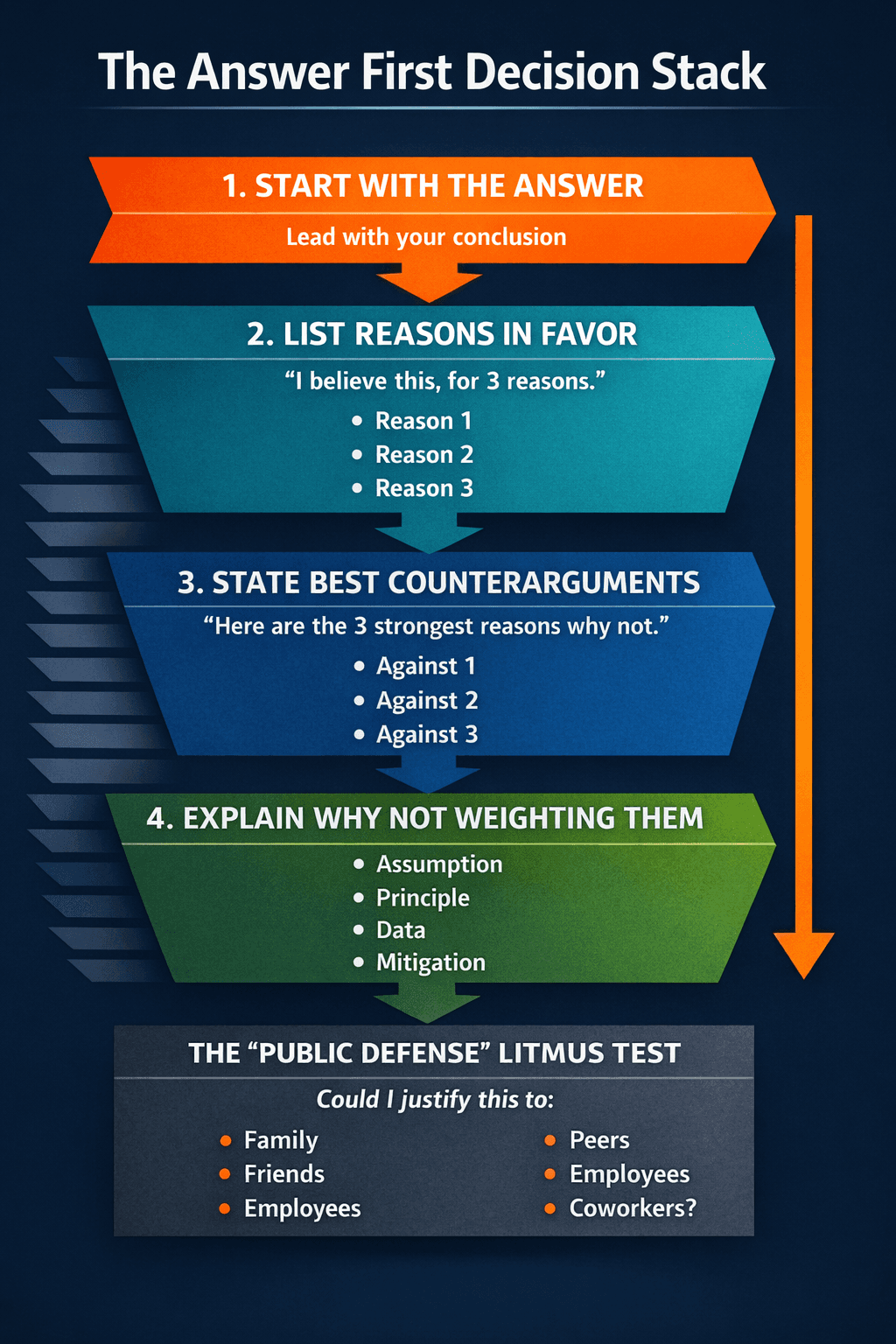
Step 1: Start with the answer
Begin by stating what you currently believe in 1 sentence.
Examples:
I believe we should give this person a meaningful raise this year
I believe we should not pursue this partnership
I believe we should ship this feature now, even if it is not perfect
I believe we should replace this vendor
If you cannot say the answer, that is already a signal. You are either missing data, avoiding conflict, or holding contradictory values.
Step 2: List your reasons immediately
State the number of reasons first, then enumerate.
I believe X, for 3 reasons:
Reason 1
Reason 2
Reason 3
Guidelines:
Keep it to 3 to 5 reasons
Make each reason distinct
Quantify and add KPIs/#s to the reasons so they can be challenged and tested (e.g., “she delivered 95% of her projects on time”, “he had 45 projects this months, that is more than 90% of his peers”)
Step 3: Counterarguments
Explicitly list the strongest arguments against your decision or discoveries that could change your mind.
The best reasons against this decision are:
Against/Discovery 1
Against/Discovery 2
Against/Discovery 3
If you cannot articulate the strongest arguments against your own view, you do not understand the decision yet.
Then for each counterargument, Re-state it and explain why it does not change the decision (include assumption, principles, data, or mitigation justifies that choice)
Personal Integrity check
Ask yourself - Would I be comfortable explaining this decision and its rationale to:
My family
My friends
My peers
My employees
If the answer is no, identify why before acting.
Summarize by restating the conclusion & defining next action
Close the loop clearly, restate the decision, key reasons and define clear next actions. If there are meaningful things that could change your mind, include them as well.
I believe we should do X
What would change my mind:
A
B
Next action:
Owner
Deadline
A decision without a next action is just a thought.
Tip: When you want advice regarding a potential decision
Use the same structure, but state uncertainty in all aspects where you have uncertainty.
Decision to make
Current leaning
Points in favor and your certainty of them and their weight
Points against and your certainty of them and their weight
Where I am stuck:
This creates a first conversation with yourself, then a productive conversation with others.